“To cruelty I must respond cruelly.
I know, my wrath does not escape me.
But in the midst of cruelty I cannot restrain my madness,
as long as life sustains me.”
—Elektra by Sophocles (trans. Mary Lefkowitz)
Prologue: Pupa
The hangar of a god, the ceiling a chandelier of canopies, boughs heavy with fruits true and holographic. This place symbolizes plenty, bounty, the cornucopia. But the roots of this place drink deep of life that came before; it is to the soil that all must return, even gods.
Beneath those branches lies the eidolon Anesidora, gouged out, dismembered—impossibly, irrevocably wounded: its shining metal tarnished in its own blood, the warm tones of its surface dull, its clawed limbs shattered. The first rays of dawn are flickering in the highest leaves: a bloodied maiden, lying dead in the undergrowth of a fecund forest.
Of this tableau of ruin, all is held in stillness, suspended, waiting for what is to come next.
One body, mortal, is curled up on the ground, jackknifed double. She does not move. Simply she breathes, slow and measured, as though she’s keeping count, as though she is practicing her respiration with an unfamiliar pair of lungs. Most of her is robed in gold, and it is beautiful as only a lord’s ichor can be, the fluid more like quicksilver than gore—not yet dried, warm still, oddly alive. It seems to whisper against itself, a muted communion in a language all its own, and it drapes across her body like a robe of dying sunlight.
The other body, immortal once, is inert entirely. It is past moving; it is past breathing, or even having a pulse. The face is gone, cleaned down to the skull by a fastidious eater, and the ribcage has been cracked open. Few internal organs remain. Most have been slurped down, the resplendent viscera too tempting to be squandered, too fine a feast. The sole element that’s gone to waste is the ichor. It has spread far, a pool, multiple brooks—there’s only so much the Mark Four can drink.
The Mark Four, now, unfolds herself. She sits up, the motion deliberate. Her eyes are the brilliant red of pomegranate seeds. This she finds unfortunate, but the ones she prefers will be back soon enough.
She stands, running her hand through her hair, smearing gold on white. Some of the color stays, clinging to the iridescent strands as though they’ve been blonde all along. Her hands flex, elegant fingers drumming against the air. Her mouth, quite crimson, draws into a smile—satisfied, superlatively so. Then she bends to pick up a veil, soaked in Anesidora’s coolant, blackened and beyond use. A slight shake of her head: she dissolves it to motes of light, and begins to conjure a new one. Pauses for a moment as she considers what she is wearing. Several options lie before her, in this as in all other matters. For now, she supposes this would have to do. It provides camouflage.
Under her breath, she hums to herself. Her gait is light. For the first time in generations, she has no burden: no garden to keep, no greenhouses to maintain, no clone labs to oversee. She will have a little vacation, no one’s mother any longer. In the most immediate future, perhaps she must keep up an act for a time, perform the part. But she has the requisite data, all of it stored in this body, this lithe and supple mainframe. She is capable of anything, more potent than she has ever been before.
She never hears the rifle shot.
⬩
The wound is mortal; that I am aware of this—even after my head has been split open—is proof that I am something a little more than mortal.
I can taste the depleted uranium that has removed most of my skull—not with my tongue, which I somehow still have, and not in the way a thing of flesh and blood might be said to taste. But the Mark Four is a remarkable platform; I never fully appreciated how its perception of the world was shaped by its ability to retain and process information. Already, my mind is reaching out, sifting the information available, dancing between bits of data to pierce the truest nature of reality. Overwhelming damage to this body has been inflicted by an armor-piercing round, fired from an anti-materiel rifle at a mere fraction of its effective range: the trajectory of the shot can be traced back to the curved limbs that make the rafters of this cavernous hangar. A little more prying, a security system subverted, another connection made, and I am aware that a weapon capable of this destructive power was reported missing from one of Ares’ armories six hours ago.
My killer was waiting for me, in the ceiling of my own home, obscured from divine senses, wielding a weapon incapable of killing a god but very capable of felling anything that breathes—
I was anticipated. Someone other than myself knew I would be here—a mortal, because they have killed me with a mortal weapon, one they had to procure illicitly. Knew, impossibly, that in the moment of my apotheosis I would be vulnerable.
All of this comes to me in a second. It does not stop my body from collapsing to the floor.
I am dying, which is an odd thing to have experienced twice in the past day. But the first time, when I lay propped against the carcass of my machine-self, I could look across the hangar and see my death coming. Now, my vision is… limited, reduced to one blood-soaked eye. My remaining ear is flat against the ground, drowning in the blood of three felled monsters—the oil of my eidolon, the ichor of my first form, the blood of my current body—which means I feel the vibrations of my assassin’s footfalls approaching more than I hear them. But what remains of my head was snapped back with such force that my neck is broken. I am inconveniently immobilized, staring to the side at the cored husk of Anesidora: a butterfly, sputtering at the edge of its burst cocoon. Hilariously, I feel nauseous.
Two combat boots come to a stop in front of my face; my eye twitches up to a half-obscured face, vibrant red lips under an anonymizing visor, combat rigging that speaks to a professional killer. I have never seen this woman in my life.
The woman kneels beside me, pulling a combat knife from her rigging. I’m most annoyed that I feel even sicker now, my stomach churning at the stench of a human in such proximity.
“Before I finish this,” she says, and though her words are measured, I can feel the grip hatred has on her tongue, malice honed into bespoke wrath, “I want you to know that you finally succeed, beyond your wildest dreams. The planet teems with vast and verdant life, and you are the eternal mother of a garden that blooms forever. I know how long you’ve wanted it, and I want you to know you were so close. But the price of your perfection is the death of all I love, and for that I will kill you.”
A scream goes up from the far side of the hangar, and in the next moment my would-be murderer is knocked away with horrible force—a gantry two stories high, used to hoist armored panels off of Anesidora during maintenance, has been hurled across the bay. Footfalls race toward me. Someone grabs my shoulder roughly, turning me over.
“Oh fuck, oh holy fuck,” shouts this new woman, one of Dionysus’s ilk—
—my dearest Methe—
“No!” My tongue fumbles at conveying my conviction, my anger; my divine will comes out as an unceremonious croak. “This is my body!”
—Dread Persephone, from whom even death turns its face, inviolably sworn to the Master of the Machine Dead. I will not die here—
“Fuck.” The peon is cursing. “Fuck. My lord… my lord, help us. Master of Revels, the voice of a thousand dances—”
She looks at me and sees death; she drops my corpse and summons the powers of her god, throwing herself after my escaping assassin. And still I feel sicker, as if my body has been poisoned and now seeks to rid itself of the corrupting toxin.
I want her out of my life. I want her out of my body—
No, no, no! I have won! Success is in my grasp; my goals have been achieved, the next step in my evolution obtained. My impertinent daughters—
—aren’t quite gone, mother dearest.
I vomit, bile pouring from my mouth. I would tear out my own throat if I could, the better to rid myself of the acid that burns and burns and burns, the hair and phlegm and bone and bile that I have eaten mixing with the brains and the blood that I have spilled. I roll over; I clutch at my head, screaming in rage. I pound at the floor and feel it crack. I imagine it is my mother’s face, splintering, falling away: the wall of a cage that I can tear open and be free of forever.
“A bit of indigestion, Lord of Harvest?”
I’m startled out of my frenzy; I look up into the face of Artemis, fine-featured and keen as a hawk’s. Her silver eyes gleam as they regard me, as she gets down on her haunches so we’re level. One hand reaches out for my chin, then she leans in to lick the ichor that’s splattered all over me—my cheeks, my nose, and finally my lips.
Her fingers grip the back of my waist. Her other hand roams down my throat, cups one of my breasts. “I love fucking on top of viscera,” she says against my mouth, breath harsh and panting. “This new form of yours, Demeter, appeals to me far more than your previous one. It’s like you were thinking of me when you made her. It’s been quite a while since we last enjoyed each other, hasn’t it? And while I prefer a bed more plush, all this blood is such an aphrodisiac…”
“Artemis,” I whisper, trying to buy myself time, trying to understand. In the back of my throat, the taste of her eyeballs—so soft and liquid, so piquant—lingers.
It is the wrong thing to say. Her hands still. Her grasp becomes hard, bruising. “Ah, my dear Demeter, giver of gifts. Would you grow for me my favorite flower?”
“If you’ll but let me go first.”
She does, stepping back, allowing me to rise on my own strength. I do so, badly, on shaky legs. All my muscles feel newly grown, weak and tremulous, though in actuality it’s because the motor cortex in my brain that has just regenerated. I won’t be able to flee—at my best I might be capable, but in this condition I’ll never outrun the Silver Huntress, let alone attempt to meet her in combat. My immediate options are poor and few. The Twins love amaranths and laurels, but this is a trick: Artemis must have her own picks, more personal, more intimate.
And even if I knew what the fucking flower is, I can’t conjure it. I try to will something forward, a single petal, a sepal, anything; I imagine it growing out of my throat, budding fast. I picture it blooming out of my palm, the way it effortlessly did from Khrysothemis’s. None of that happens. Mother may very well be preventing the manifestation. It’d be characteristic.
Artemis looks on, her gaze cold, waiting.
“We’re on the edge of understanding of our new selves, transferring our godhoods into something less,” I say, shaping my cadence and intonation to resemble my mother’s as much as possible; I make my best guess at my mother’s ambitions. “The Mark Four is a remarkable platform; its regenerative capabilities are unmatched. Even so, I am not yet fully myself. In a day or two I’ll give you as many bouquets as you like.”
Her eyes gleam, bright, the eagerness of a predator that’s spotted prey. She raises her hand; a knife materializes within it, long and tapered. “It looks like Demeter didn’t emerge in control of this platform. No matter. I will cut her out of you, Mark Four. As many times as it takes.”
The rifle shot. The way I fell. The world narrows down to this possibility—that it was Artemis who struck me, my mother, down. Except why would the Huntress require firearms? She’s never been known to use any. At the very least, I can throw this back at her, buy my newfound regeneration precious seconds, see if she reveals more about the conspiracy my mother apparently had with her. “Is that why you sent a human to hunt for you, using one of Ares’s rifles? I thought you better than that.”
This seems to genuinely surprise her, and her lips curl into an insulted snarl. “I would never stoop so low. I don’t even know what you are talking about. I came at the time you—Demeter—requested, and found you vomiting out your guts.”
I affect an exasperated sigh, one that is too easy to emulate; I heard it often enough, with my ears and in my dreams, her disappointment. “I was shot by an assassin! She cleaved my head open at the moment of ascension. Someone anticipated this, someone that neither you nor I know.” I keep my voice steady, laying out what has happened in a tone that will not brook dissent. “Dionysus’s woman was here, and she’s already called upon the power of her god. The rest of the Twelve will soon arrive. Will you cut me apart with them as witnesses? Step very carefully, huntress; I could easily tell them I found you above my mother’s remains, hunting blade in hand.”
Slowly Artemis sheathes her knife. And indeed, at the hangar’s mouth, the lords have come—not Dionysus first, but my own: Hades and Hephaestus, followed closely by Hera.
But then the Lord of the Hunt draws close to me and lowers her voice. “Be that as it may, what will you tell them—admit to Demeter’s plans? You’re not going to be able to pretend you’re entirely yourself for much longer… Mark Four.”
At first I do not understand, but then she gestures down. I look into the blood that has spread across the entire hangar floor, more blood than a human body can hold, as smooth and reflective as glass. One of my eyes is the brilliant red of pomegranate seeds.
The other, the one that regrew, is a peculiar blue-purple, the pupil in the shape of a blooming rose. I have seen this eye before; it was the first thing I ever beheld, the eye that balefully watched my maturation, judged my performance, revealed when I knew success, occluded when I disappointed.
It is the eye of my mother.
One: General of Old
HADES
Hades arrives to the sort of butchery that hasn’t been seen in generations. The hangar is an abattoir, the symbols of plenty and harvest coated in blood and ichor and coolant. The ruin of Anesidora is nearly as thoroughly shattered as Keraunios’s, and done with a different force of intention. She has been torn asunder, panel by panel, not in the dispassion of combat, but in something altogether more personal. A desecration.
The Master of the Machine Dead is intimately familiar with carnage. For all that she’s tried to leave it behind, to pretend there is no longer any need for the General Triumphant, the hardest part of her was forged by war. The filth of the Titanomachy has stayed with her, staining her hands and her thoughts. There was a period—when dissent had not yet turned violent, when Hephaestus’s eidolons were contingency and not necessity—that the inchoate rebellion believed they could avoid bloodshed. They were kin, and if they had to spend a coin to purchase victory, it would be mortal red and never immortal gold.
But then Hermes betrayed his comrades, fled to Rhea and shared every detail of the resistance. Zeus’s wrath could not be constrained; she abandoned the safety of their hidden bases and stalked Hermes through the city with savagery clenched between her teeth. She fell on him not with the speed and brilliance of her famed lightning but with an earth-shattering viciousness that leveled buildings. Zeus and Hades closed ranks mercilessly. They would suffer no traitors.
Hades has interred uncountable bodies since—death becoming rote, dressed up in obsequies—but none of them gods. Now, two of them are gone between the jaws of a single day. First, golden Zeus fell against the Harvester, her eidolon body Keraunios torn apart and her pilot Herakles devoured.
With a hitch, Hades realizes how complacent she’s become with their facade of immortality. Faced with the cratered shell of Anesidora—the snapped clavicular axle, leaking sparks and shedding chips of alloy, the hollowed belly stripped down to its reedy chassis, everything glistening under the lights—Hades feels small and wet and out of place, like a removed organ.
And amidst all this, Artemis and Persephone.
Hades’s first instinct is to leap forward and take Persephone in her arms, to hold and comfort her champion. To wipe the blood away, to check her body for injury. As with Leuce, Hades has already gotten too used to suffering the blows together. Not long ago, the Harvester left them both bruised and exhausted. Despite the warm thread that ties Persephone to her, she cannot tell what is going on behind her pilot’s eyes. What wound has her mother inflicted this time? But a regent cannot be swayed by personal concerns, before a crisis of this gravity; Hades must remain where she is, detached and stern, the portrait of objectivity.
Persephone’s white hair is plastered to her skin; matted and clumped, it falls over one eye, obscuring nearly half her face. The fabric of her robe is stiff, dyed gold and red, the two fluids never mixing. Often the ichor overwhelms, giving her the look of a statue half-gilded, whose sculptor got distracted or viciously slaughtered in the middle of creation. And she is almost as unmoving as a sculpture, too, kneeling in the gore, inanimate save for the telltale signs of respiration.
The Lord of the Hunt keeps her hands primly at her sides, though she too is splattered with red here and there. Her expression is distant, almost dreamy. With both of them foregrounded against the wreck of Anesidora—and Demeter’s fleshly remains, the spill of organs, the skull picked clean—there are few available conclusions to draw. The tableau they make, side by side, is incongruous and unlikely: it is both beautiful and damning.
The other lords have marched inside, standing behind Hades if only because she is regent and formality must be observed; she glances over, and finds in every face the same suspicion. Dionysus presents herself in her champion Methe, the mortal’s eyes shining with the burgundy radiance of her god, mouth severely pursed. Apollo is frowning at eir sister, as though they are—for the first time since they separated in two—in discord.
Hades parses the rest: Aphrodite and Ares are aghast, eyes wide and mouths slightly ajar, as if this is all too bitter to swallow. They were soldiers, with a pair of Titans conquered between them. They know well what such violence might presage. Hephaestus is coldly knowing, having already seen in the state of Demeter’s corpse the same possibility that Hades anticipates.
The One Who Watches is, as ever, stoic; her face bears the same veneer it always has. Perhaps she’s already calculated this event; perhaps she has already foreseen, and has chosen not to disclose because it serves the purposes of her other equations, the other events that are to come. The same way she did not tell of Keraunios’s fall and the consumption of Herakles. Not for the first time, Hades considers how alien Athena is, this thought-daughter of Zeus, the one who sprang forth in a manner like no other.
And then, Hera: in Olympus’s queen there is abject horror. Hades might have missed it if she weren’t so intently divining every single expression of her fellow lords. It is gone quickly. Hera’s composure is nothing if not legendary, tested across three generations. There is something she knows that the rest of them don’t. Zeus told her, then, of the true horrors of the gala. Did Zeus tell Athena, too? Is Artemis aware? Her sandals have been burnished by Demeter’s ichor. Did she arrive to see Persephone consume her mother?
Hephaestus, sudden, strides forward. Ze bends to the floor; ze dips a finger in the blood, brings it to zer tongue. When ze looks up, ze says through red lips, “This belongs to the Mark Four. It is indubitable.”
Dionysus tilts her head. Then quickly, quite clinically, she has a taste too. “This I can attest: the DNA is hers. I assume we don’t all want to lick demigod gore off the floor, that becomes embarrassing fast.”
That fails to cut the tension, but no other lord steps forward to bio-analyze the blood. Hades holds up a hand. “To order, Lords of Elysium.” She projects her voice and draws out a note of the general of old. Some of the gods flinch upon hearing it, as if struck. “We stand before a grievous crime.” Her nod is brusque as though the loss of Demeter is an anticipated casualty in a long and terrible war—and in a sense it is, for the old witch almost certainly planned and engendered it herself. Less hostile action; more treachery from within. “And also an inexplicable one. Fortunately we also have two witnesses before us. Mark Four, Artemis—the two of you will explain yourself.” If that is Persephone anymore; if another consciousness has not taken over.
But Artemis speaks up first. “When I arrived, Anesidora was already destroyed and someone had fired this large-caliber bullet from above, a spot in the ceiling. The ammunition was left behind.” She holds it up now, the spent shell of it dull gray and warped as though it was subjected to heat as strong as Hephaestus’s forge. “I was at here to retrieve a fresh bushel of Marks Two for my estate. Her daughter came, it seems, at the same time.”
“You didn’t send a retainer to pick up the clones?” Hephaestus asks.
“I like to be hands-on with my prey.” Artemis shrugs. “Give them a personal examination; make sure they’re high quality.” This is plausible, at the very least. The Twins’ estate is the largest purchaser of clones in the city.
The weight of the gods’ gazes falls upon Persephone.
“I had a premonition,” says Persephone. “I followed it to find my sisters massacred, Anesidora destroyed, and my mother—in this state.”
“And where is this sniper now?”
The pilot spreads her hands. “I wouldn’t know. This blood, Lord of Desire, belongs to me—I was shot at, by the very assassin the Silver Huntress indicated was here. I didn’t see the attacker, only sustained this injury.”
Silence, for a time. Perhaps they’re all thinking: was this how the Titans convened, after the first of them fell? Speculating, bickering, helpless before the truth of what should be impossible—a death that changes the nature of their reign completely, a gulf opening under their feet when before there was stable ground.
Athena studies each of them, one by one, before she says, “As of thirty-six minutes ago, an anti-materiel rifle was reported missing from an armory by Wall Caryatid. It is capable of piercing a colossus.”
At this Ares blinks, then—reluctant, Hades thinks—nods. “Yes. I was in the middle of reading that report, in fact, but this is a touch more pressing.”
Hephaestus glances at the One Who Watches. “So you’re saying there was a mortal assailant who wished the Champion of the Underworld ill? For no god or colossus would have required a rifle. And the Mark Four wasn’t likely to have climbed up the rafters to shoot herself.”
Behind Hades, Apollo laughs. It is not a mirthful sound. Ey draws close, meaning to move to eir sister’s side, but Hades blocks eir path with an arm, and then—her old specialty, so rarely seen anymore—with darkness. It radiates out from her, spreading as ink in water, blotting out the exit and blotting out all light. The cold dark seems intangible, insubstantial, but every god present is aware that it will become otherwise if necessary.
“Both my pilot and Artemis will be put under house arrest,” Hades says in a voice that brooks no disagreement. “That will be lifted once their names are cleared. To this end, I task Hera—just and fair, Queen of Eternity—with the investigation of Demeter’s demise. She is to act as she sees fit to fulfill her objective. The Mark Four and the Lord of the Hunt shall cooperate with her in any manner she wishes.”
“You impinge on the dignity of my sister,” Apollo snaps.
Calmly, Hades turns to the Lord of the Sun, who shines gold even now, illuminating corners of the hangar and casting strange half-shadows. “Three generations ago I came close to killing you while your sister watched, Apollo, to prove to you both that I had what it took to rebel against our makers.” In her voice is the image of her fist around Apollo’s loud-beating heart as she persuaded the twins to her and Zeus’s cause.
Artemis stirs too, her lips parted just so, to show her long canines tipped in silver. But she does no more than the slightest of movements. A hunter’s patience. All possibilities hang in balance, the hangar air fevered with it, attention now drawn to Hades rather than to the carcass of Anesidora. Apollo’s brilliance grows brighter, as though ey means to burn away the dark.
Anticipating violence, Artemis raises her hand. “No need, dear sibling. I shall make myself available to the queen, and otherwise remain at our estate.”
It is meek, for Artemis, but Hades doesn’t have time for her suspicions: now is the time to decide, to test her authority as regent. “Pallas Athena, protector of all that is virtuous: to you falls the responsibility of containing information on my sister the king.”
The Lord of Wisdom inclines her head, though Hades already knows she will do as she pleases, regardless. But she of all the lords understands the importance of keeping Zeus’s true state from mortal knowledge, and she too is the most suitable to the responsibility.
“Lords of Wine and Beauty” Hades goes on, “I’d like you to work on agriculture and food supplies.” Outside of Demeter, they were the only two gods with any sort of agricultural experience, having more traditional vertical hydro-farms on their estates. “The queen and I will permit any resources you require to reverse engineer and restart Demeter’s production lines.” She makes this sound more like a request, more courteous, but she also knows Aphrodite has long chafed at her meager responsibilities—lichen growing, what a snub for a scientist of her caliber.
And it does mollify her, for all that she evidently mislikes the handling of Persephone and Artemis: it is clear that she’d prefer both under lock and key. Her gaze turns distant, as though she’s already begun to calculate what she will need. “It’ll be an honor to oversee that.”
Methe-Dionysus nods, in turn. “And the rest of us, regent?”
“Ares and Apollo are to handle defense of Wall Caryatid—”
“I will do no such thing,” growls Apollo, “until my sister is released from her pointless house arrest. You’ll have my obedience then, General, and not a moment sooner.”
The glare of em has become a conflagration. Hades allows it for less than a minute before she overwhelms eir radiance: hers is the lightlessness beneath the earth, where jewels and metals lie dreaming. The darkness far beneath the surface of Olympus, far from any life, such monstrous depths that the barren wastes seem comforting and hospitable in compare. It is summoned now, and it swallows whole the light of Apollo, an act of devouring as complete as jaws snapping shut around prey. There is no more glimpse of the sun; the possibility of day itself vanishes. The lords hold themselves still; the lords hold their breath.
Then she lets go. The hangar is once more illuminated in the green-gold, crepuscular shine particular to Demeter’s estate. But the cold remains. The perfect summer of harvest has given way to a patina of rime across the remains of Anesidora, the floor, the branches above. Leaves have begun to brown; fruits have bruised, as if frostbitten.
“I cannot make you defend the wall,” Hades says, very calm. “Mandating such would only make you a liability to Ares and xer barracks. I trust you’ll understand, Apollo—as your and your sister’s light touches all the surface of Elysium, the darkness beneath the earth too reaches all, and may find anything it wishes.”
Apollo’s jaw tightens, but ey bends eir head, and then bends eir knee. An understanding has dawned, if only for now; the twins have ever respected most a show of force. Artemis has a strange look about her, fascinated and intrigued.
Hades turns to the rest of the lords.
“This council of the gods is adjourned.”
PERSEPHONE
Most of the other lords have departed; Hades and Hera remain. Before I can say anything, though, my lord reaches for me. The severity of her expression softens, just a fraction, as she runs her fingers along my jawline, then brushes my gore-matted hair away from my face.
A moment of terror, but she shows no undue reaction. One glance into the mirrored pool of gore beneath us tells me why. The blue-purple eye with its rose petals has faded. My iris is simply red again, all my own. Relief electrifies me, nearly brings me to my knees. I get a hold of myself, and then we exit into the garden of my mother.
We stand in the aftermath of a massacre: the sister-corpses, the torn leaves and crushed fruits, the shattered panes from greenhouses. Some of it is new to me—on the way in, we were all in a rush and had little time to examine—and I wonder now at the red depths of Khrysothemis’s rage, the capacity for this latent within her all along, a seed waiting for the moment of spring.
I glance at my lord, and think of what she just demonstrated within the hangar; she has moved her hand to my elbow, a light contact. I want more, but this little I must bear with; now is not the time for open affection, with Hera lingering and watching us.
Quickly I fold my fist across my heart and bow to the queen. Her expression is neutral as she regards me; it occurs to me that she should be adversarial, for I am the product of conspiring between her wife and my mother, as good as proof of Zeus’s infidelity.
But Hera gives no hint as to any animosity: her cobalt eyes are merely wary. What she wears is like nothing I’ve ever seen on her before. In broadcasts and public events, she favors gowns of opalescent colors, in peacock shades or stark white, fabrics heavy and undulating as a tide. Now she wears sleek armor in muted indigo, almost the same uniform as what her secret police the Krypteia wears, as unforgiving in its angles and design. It is as though she expected to find something dangerous. Something she might have to fight, suppress, kill.
Hera says, in a perfectly calm voice, “I require access to the Mark Four, regent.”
My lord nods—it is after all what she has just promised Hera, and by extension so have I. “As you wish, Potnia.”
I’ve gotten more used to the sensation, so the transportation does not disorient me quite as much. But still, a ripple of vertigo, the anticipation of a hard landing that jolts my nervous system. Instead it is as though we have simply stood up and walked to another room. I marvel at it again, this sheer ease of existence, something that seems small next to the grander powers of the gods but which nevertheless spells out the kind of freedom—the transcending of mortality—I’ll never quite enjoy.
Hera’s office is an expanse of pale marble capillaried in rose gold, frosted glass, and a curved ceiling screen on which a strange bird flies across a never-ending landscape. Sometimes it has the queen’s eyes, and the world beneath weaves itself from black canopies, blue seas; unweaves itself again into fractals of sapphire and citrine. This vision and its aspects fascinate the eye—I find myself drawn to the mathematical puzzles within them, the spiraling calculations necessary to generate them. There’s something secret there, something divine, a little like what my mother gave me to solve. And if I can just solve this, if I can gain possession of the computing there, I would attain something godly—
A touch on the back of my hand. “Hera will need to examine you,” Hades says. Her voice is gentle but firm. This is not the time for my defiance. The two of them have forged an alliance, that much I can intuit. I cannot parse out its parameters, but I suspect in exchange for allowing the queen to study me, Hera will stand with Hades during her transition to power. At the very least, in the investigation of my mother’s murder. So be it. It is better to let Hera learn limited information until I can divulge to my lord the entirety of the matter.
I bow deeply to the queen, and murmur, “It is an honor to be of service to Your Majesty.”
The queen half-snorts. “As if something my wife commissioned could be so humble, but it’s good to have you cooperative.” She claps her hand, once, untheatrical.
A partition in the office lowers, revealing a second, smaller chamber. This one is windowless, with half of it depressed and walled off like—oddly—a shower stall. The same white marble lines the area. I expect instruments and monitors, but there are none.
At Hera’s gesture, I step in there, certain that under my lord’s watch no lasting harm will come to me. A little pain and indignity can be borne, within certain parameters. I am still dressed in the crimson robe of Hephaestus’ making, still wearing the collar picked out of Hephaestus’s workshop: the black steel with their flourishes nodding to both my lords, the rubies arranged in a way that makes me think of the swarm-nodes.
Wordlessly, Hera removes the collar and sets it aside—surprisingly carefully—and then sets to the work of peeling off my robe. This she drops into a container, likely to analyze later. She doesn’t wear gloves, but then a god cannot meaningfully contaminate forensic samples. It is interesting to be touched by a lord other than mine, for all that Hera’s investigations are clinical, economic in their movements. The Queen of Olympus has neat hands with strong fingers, her nails kept at a precise length—stately, neither too long nor too short. It is from her, more than from Zeus, that Elysium’s mores of propriety flow. How to hold yourself, how to eat, how to conduct rituals of the domicile; from table manners to marriage, the Lord of Eternity holds sway.
“I’ve been reviewing logs,” Hera says, almost conversationally and directed at Hades. “The resources my wife poured into the Mark Four were nearly unconscionable, if understandable because she thought she was going to get twelve of them and not subsidizing Demeter’s vanity project. But truth be told, Hades, I wouldn’t have tolerated the Mark Four as my pilot.”
I make an effort to control my face. On her part, my lord says, “I have been well satisfied with her. No other pilot has achieved this synchronization rate, and her performance you can judge for yourself. On every metric—”
“She lacks devotion.” The queen clicks her tongue. “No doubt her mother’s design. I doubt you would be so pleased with her duties as a pilot if she did not satisfy you in other ways, Hades.”
Does she mean she’d have found me effortless to resist, or does she mean she genuinely is that faithful to her faithless wife? I know what my mother thought of Hera—nothing flattering—but I find it hard to believe the queen hasn’t had her own dalliances. Who could possibly reprimand her? Would Zeus have?
“It is the result that matters, o queen,” murmurs Hades, amused rather than offended. Whatever deal they have made or are making is amicable, then.
Once I stand naked before them both, a ring of pale light runs across me head to toe, a preliminary scan. The queen reads. “Vital signs are within expected ranges. Physically everything is to specifications, and network emissions are likewise.”
Whether she got my specifications from her wife’s files or from Hades… no matter. In the meantime, though, I’ve learned through observation that my mother built me to lure the gods, and there is a question: since I’ve tested myself against Hephaestus and Hades, could I tempt another lord?
Hera now pours solvent into her hands, and begins to massage it into my hair, loosening the dried gore and semi-viscous ichor. I angle myself, in plausibly deniable ways: tilting my head to bare my throat to her, letting the light fall on the cords of my neck, my clavicles. Doing all I can, naturally, to help her access all the forensic samples. She remains wordless as she collects, until she interrupts herself: “The Mark Four smells of ozone and burned wood. That doesn’t seem usual for a daughter of Demeter.” Her voice is a little tight, more than merely bemused.
My lord blinks, for of course to her I don’t smell like that. The Mark Two line bears the fragrance of nectar and flowers, designed to please and delight. But I’ve suspected for some time that, in moments of intimacy, I smell like what the other person desires the most. An edge Demeter gave me, to ensure my place in whatever household I sent myself to; to ensure the rest of her scheme would unspool precisely as she plotted. Ozone, I wonder; is that the scent of Zeus?
I lower my pale, snowdrift lashes. I smile, slow.
Hera’s mouth thins, and she continues to work on me, removing smudges of ichor and blood. But the longer she touches me, the more her fingers linger. Divine and mortal fluids gather between my breasts and across my stomach, turning to liquid again under her careful work; they remain separate too, repelling each other even now.
The queen sweeps her hand over my belly, brushing the trail of white hair there leading downward. Her fingers stop, dip in the not-quite-mixture, this thing that refuses to commingle. Then she breathes deep—the ozone, the burnt wood—and slips her fingertips into her mouth. She sucks; the two fingers sink between her platinum lips, deep then deeper, to the knuckles.
Behind her, my lord stiffens. Hades’s hands don’t entirely close into fists, but the fingers twitch toward the possibility—I suddenly want to feel her hands on me, hard with a bruising demand. It is rare that she is so possessive; sharing me with Hephaestus is one thing, Hera having a taste of me is quite another. Neither of them will exactly break into an altercation over me, but the prospect is an arousing one. The thought of violence between the lords always tempts me, a spectacle waiting to erupt. A shame, in retrospect, that I wasn’t there to see the fistfight between my lord and her sister.
Hera removes her fingers from her mouth; she is not flushed, but she’s breathing a little fast, and my blood has left a smudge on the corner of her lips. “This is Demeter’s ichor, and your blood. There is a great deal of both—this amount of hemorrhage ought to have killed you. Have you an explanation for both, Mark Four?”
“By the time I arrived, my lord mother was already fatally injured. As any pious daughter would, I tried to see if she was still alive and whether I could give her aid.” This I say with a perfectly straight face. “Unfortunately, my mother’s assassin was lying in wait, in her very hangar. They shot me before I could ascertain their identity or even appearance.”
The queen leans forward. “And how did you survive it? There is no open injury on you.”
This is the difficult part—regenerative capabilities are not on my specs sheet. An aspect my mother wished to conceal, though it’d have come out in any case. “I was built to be the consummate pilot, one who could perform beyond any mortal,” I offer blandly. “What good would a pilot be who can’t keep fighting after losing a limb or two? The colossi, my queen, are deadly.”
She barks a short, hard laugh. “In what location were you shot?”
“Through my stomach, Your Majesty.” To my fortune, my brain matter didn’t splatter the floor, or Dionysus would have tasted it and known precisely where the bullet hit.
“This assassin,” she says, “was able to destroy Anesidora and murder Demeter, but they didn’t have the sense or aptitude to shoot you in the head?”
“Perhaps they did not have time, or perhaps they thought me far less a threat—and certainly less of a priority.” I spread my hands, which conveniently lifts my small breasts. “The attacker was mighty, but I think a mortal. Despite their planning, ultimately incapable of divine feats.”
Hera blinks, once, checking her datasphere. I wonder what she’s cross-referencing me against; what evidence she has, what she saw inside the hangar that I didn’t. There are things she knows that I don’t, almost certainly pertaining to the assassin, who concerns her very much. For the usual reasons, first: no mortal should be able to execute a god. But there’s something more too, an undertone of—fear, yes, that is it. In her cobalt eyes burns a deep terror, the surety that her worst nightmare has returned. It is more atavistic, more personal, than the fall of another lord.
Barely conscious of it, I cant myself toward her and draw in her scent: lilies, subtle and regal, masking her horror. Of me? Of the mystery that she hasn’t been able to solve? My stomach warms with hunger. To have her, to understand her, to taste her as she’s tasted me.
The queen’s voice is sharp when she says, “Normally the Krypteia decontamination process requires that the subject is purged of all her lymph and gut microbiome, to be replaced with purified synthetics. But I imagine you haven’t the time to wait for all that, regent. I’ll sanitize your pilot and return her to your custody. Artemis is next, let us hope she’ll be as… cooperative.”
The rest is mundane—soap, water, disinfectant. Still under Hera’s hands, though; it surprises me she hasn’t summoned a nymph to begin with. Maybe only she can do this right, can analyze the fluids as she has. Hades drapes me in a conjured copy of one of the dresses that Hephaestus made, and returns the collar to my neck, a reminder that I am her and Hephaestus’s possession. It feels good to have it back.
⬩
We return to my lord’s estate to find it uncommonly crowded: at the gates await Hephaestus, the Cerberus Cadre, and members of Hades’s clergy—they all kneel at our approach, heads bowed. I consider the three priestesses present, all new to me since I’ve never paid attention to individual devotees to the faith of the Underworld. Two look ordinary enough, a petite woman with bright red hair who kneels close to Cedalion, and a brunette of thin frame and warm brown skin. The third takes me by surprise. If I didn’t know better, I would think I’m looking at a Mark Two. As I get closer the distinction becomes clear. She doesn’t bear the scent of flowers, and the phenotype is too divergent. Likely chasing beauty trends.
Myia bears a tray of freshly baked tarts, a platter of cured meat, cheese, and pomegranate seeds. I’m suddenly famished, and well I should be given that I had to regenerate most of my skull. I wait for Hades to murmur, “Rise,” to the Cadre and the priestesses before I tear into the food. I do keep it reasonably decorous even as I long to pour the entire platter into my mouth.
“Welcome back, Champion of the Underworld,” Myia says.
“Hello, Myia and my Hounds. And who would these be?”
The nymph bows toward the priestesses. “The Meténeion has sent three of their most devout acolytes to serve at the estate, my lady. Sisters Madalithea, Lydia, and Cassiphone.”
A flicker goes through Hades’s expression—she prefers solitude the most, but I can see what is happening: raised to Elysium’s regent, worship of her must now be entwined with statecraft. Much as the Lord of Thunder kept hierophants in her palace, Hades must now don the ruler’s regalia, and maintaining a minimum of pomp and ceremony in her place of residence. When the other gods and their retinue visit, they’ll see these symbols of station, the trappings of a crown invisible yet undeniable.
On zer part, Hephaestus does not offer comment; ze knows the same thing I do, though there’s a slight crease between zer brows. Ze, too, does not like interlopers in the estate.
“Master of the Underworld,” says the tall acolyte, “the Prince Ascendant Who Reigns Deathless. We place ourselves under your sacred command.”
“Welcome, sisters.” Hades inclines her head, gracious even as her new title seems to sit poorly with her. “The nymphs will see you to your quarters in the outer wing. My regards to your sybil.”
I lick pomegranate juices off my fingers. Hephaestus takes a wet serviette from Myia and wipes my hands and mouth, a gesture that strikes me as both fond and almost too intimate for public view. I nod my thanks while faintly wondering what the priestesses would taste like. “Why did the sybil not come herself?” Odd to send over mere acolytes, however pious.
The redhead looks up at me—she is so small, only a little taller than Hippolyta—and starts stammering. Once she’s gathered herself, she says, “The Meténeion, as the foremost temple to the lord, has received an unprecedented number of worshipers, my lady.”
Meaning the sybil, and other high-ranking clergy for that matter, are much too occupied handling the crisis; it falls to their favorites—these three—to serve the estate in person. Fair enough. I look the redhead over again; she bears every sign of prey, even down to her scent, faintly sweet. Perhaps her sybil thinks I am in need of emergency rations. “Thank you, Sister Madalithea. You must teach me all the hymns.”
She flushes, cheeks almost as red as her hair, and bows so deeply that her head and cypress leaf pendant nearly scrape the grass. Myia then escorts her and the others off to wherever they’ll be staying. The Cadre stays behind to take commands from my lords regarding estate security, especially now that we have newcomers. I don’t miss, though, that Cedalion gazes after the departing acolytes a minute too long.
Curious, I access the estate’s logs and find that Sister Madalithea has visited on more than one occasion, as Cedalion’s guest. I pass no judgment on my Hounds for how they choose to amuse themselves, but attachment hardly seems like them. I catch her as the Cadre makes to leave.
“Cedalion, that red-haired acolyte—she’s been here before.”
My Hound pauses. Warmth brightens her golden eyes. “Sister Madalithea is very dear to me, Champion.”
“I see,” I say. “She seems…” I search for the word. Fragile? Ordinary? “Devoted.”
“She is, Champion.” A hint of a smile tugs at her lips as she salutes, before turning to catch up with her sisters.
I study Cedalion at a distance, this consummate instrument of war declaring affection for something so timid and breakable. The acolyte trembled just meeting my gaze, small and terribly mortal. The impropriety, the scandal even, of my Hound dating a maiden of the estate.
Soon, my lords and I are finally alone among the white poplars of the estate’s inner, open-air garden. Pale leaves gather on the ground, little mounds of pretend-snowdrift, alluding to a winter that is impossible and which will never arrive in Elysium and its seasonless habitation dome.
I begin, “I need to tell both of you what happened in Demeter’s estate.”
Hades and Hephaestus are quiet as I explain that my sister communicated with me and sent me to my mother’s hangar, where I found Demeter fallen. “Then the assassin shot me in the head, and when I was conscious again Methe called for aid, and Artemis…” I pause, backtracking, realizing that I’ve skipped over the crucial part. As though my thoughts were made to glide over it, glass on oiled surface.
Nor can I remember anything clear about the assassin either, even though I should be able to tell more than I have. I am a supernal analytic machine. Everything that happens to me should exist as a crystalline record, more than eidetic. The sight, the sound, the smell. The exact caliber of the bullet that tore through me; the fleeting thought that I could have traced the firearm to its source, isolated that down to the hour and minute, for such a weapon is not ordinary. But all that has dissolved, as though I’ve been made to forget.
A sound like the faintest of whispers, and a glimpse; over my shoulder there is a figure standing in the distance, tall and veiled and familiar, among the poplars that would never have grown in her garden. Her red mouth is curved in a smile. She is translucent, there and not there.
No. My body is mine. I will the sight of my mother to vanish, and she does. Her laughter curls up like smoke.
“Demeter guided me to her estate,” I say at last, the sequence of events coming to me, lucid and definite. “There I was overridden to consume her, a process that she believes will let her take me over from within, and rebirth herself as a fully developed Mark Four platform. Why she desired this, I don’t yet know, but the assassin’s shot interrupted Demeter. For now, she’s been… suppressed.”
At this rush of words, the surface tension of me punctures. My balance teeters: I sway and would have fallen if Hephaestus hadn’t caught me. I breathe and breathe against zer strong arm, drawing in the scents of the forge, those warm pleasant notes of industry and honest labor.
“We know,” Hades says.
“You—what?”
“You’ve clarified some details, certainly. It’s why I allowed Hera to examine you. It’s important to follow protocols and maintain some sense of remove from this.”
“Allowed,” Hephaestus huffs and cuts Hades a look. I wonder if ze, too, shares my apprehension around Hades’s quick alliance. “Regardless, it’s the real reason why you’ve been put under house arrest,” ze adds. “You needn’t worry. We will protect you, even from yourself. Let’s get you into the clinic first, ensure there are no irregularities. Hera’s study of you could have done only so much.”
I straighten myself, staring at them both. “You knew. And you aren’t considering executing me. If I were the two of you, I’d be locking me up and dissecting me inside a lab.” This is not the time to be soft. This is the time to be ruthless, to open me up and extract my mother from me like the tumor that she is. Any pain would be bearable; any torture inflicted upon me would be not only logical but understandable. “My lords, you’re being foolish.”
Hades gives me a long look, quiet for so many seconds that I expect she’ll come around after all, and bring me under the scalpel. “We will not be doing that, my pilot. If Demeter could be so easily dealt with—merely cutting her out with primitive tools—then she would never have succeeded in any of her schemes. Let us perform scans on you first, as thoroughly as we can, and then we’ll see what needs to be done.”
HADES
Hades and Hera have met over Zeus’s body more times in the past two days than they have in the preceding month, perhaps ever; outside of council sessions, they have had little reason to interact. But now Hades’s sister and Hera’s wife lies comatose between them, and necessity demands this fallow field bloom with the fruit of unexpected collaboration.
There is a dark comedy, Hades thinks, in what they’ve fed the public: that Zeus is in mourning. It builds on the lie that Hades told the CIC officers when her sister fell insensate the instant Keraunios and its pilot were ripped from the sky. Zeus took religious seclusions frequently, and the death of a pilot—especially one as lauded and relatively long-serving as Herakles—gave plausible cause. The citizens believe their grief and contemplation are being reflected in their king, yet in truth it is Hades and Hera who grieve, Hades and Hera who have none of the respite they pretend Zeus has retreated to.
Hera still smells of soap and antiseptic from studying Persephone and Artemis; she must have come here to be with Zeus immediately afterward. With a wave of her hand, she summons a chair for Hades to sit beside her, next to the bed their shared charge occupies. Hades sags into it.
Without words, they begin what has already become ritual between them. Hera passes the hand of the king over, warm only from her touch, and Hades reaches out from that well of divinity in her, the gold of her seeking the gold in her sister. It pricks like the bevel of a needle. Each of them has been feeding Zeus a fraction of their essence, on the chance that it might ease the king’s suffering; they guard their hearts against the unspoken hope that it will restore Zeus to consciousness. More than once Hades has wondered what would happen if she pours all she has into Zeus at once: would it succeed? Would the flame of her, passed in whole, resurrect her sister—reignite Zeus’s brightness?
Neither know if their efforts are a waste; for all their power, the gods understand themselves least. The nature of their divinity and the limits of their power were secrets their creators took to the grave. Hades assumes the iconography of the other gods reveal their own personal preoccupations—perhaps to Dionysus, divinity is like a vine ever-flourishing, and to Athena it is an ever-watchful owl—but in truth, she doesn’t know. For too long, the Lord of the Machine Dead shunned understanding herself, and in so doing averted herself from knowing others. Her greatest aspiration was to let the flame of her divinity flicker in darkness, like a vigil candle illuminating the mausoleums of a better, past age. It took Hades all her life to understand what drove her sister to shine like the sun.
Now that sun has set, and all Hades wants is to plunge back into the dark. To reduce herself to the votive offering, or let herself burn in a conflagration, and from that pyre let her sister again rise. She teeters on the edge of the abyss.
But the crown she ran from has found her head, and the weight of it has brought clarity. Hades has always styled herself a remembrancer, the one through whom all legacy might live on. And what is this crown, if not the sum of her sister’s legacy? To shirk it would be to lose her sister again.
“What do you make of the investigation so far?” she asks.
Hera does not look up from her ministrations over Zeus, but after a moment she pulls her hands away and folds them into her lap. There is an awkwardness to both of them, a momentary hesitance in each and every action. It’s the same hesitance that almost drove Hades to break decorum and bring Persephone back to the Underworld immediately. All lords distrust each other and Hera is no exception, but after a time, she begins to expand her datasphere, revealing what her Krypteia have collected from Anesidora’s hangar. It isn’t much more than the gods discerned at first glance, but—
“She killed her mother,” Hera says, gesturing to a forensic report on the blood, reconstructing a time and cause of death. “That much is obvious. The more interesting question is how.”
Hades’s head snaps up. She has steeled herself for this conversation ever since she tasked Hera with investigating the assassination. It wasn’t an unfounded decision, and not purely one of propriety, either. When they first met over Zeus’s body, the necessity of an accord between them was glaring. Hades could not stake her regency on nothing but goodwill, and Hera had all the experience of governance. Still, Hades has spent the intervening hours plotting out how to explain Persephone’s complicity to the queen…
Who is now giving a good-natured chuckle. “I assumed that was the case from the moment I saw Persephone with ichor on her teeth. Analyzing her in my estate only solidified that fact. That you entrusted me with sealing the crime scene and sanitizing Persephone indicated you were pulling me into your conspiracy. Is that not the case?”
“It is, but there’s more,” Hades begins, but the queen waves a hand.
“It’s not an accusation, Hades. It’s just statecraft. Secrets and trust are the coins of being king.” She pauses, letting her eyes rove over Hades’s still-confused scowl, now deepened into anger. “I think you have this impression of my sister, that she kept her secrets from everyone. And you want to be a better king than her, succeed where she failed, treat me with the respect and consideration due your compatriot in rule?”
Hades tries not to react—is she that transparent?
This time, the Lord of Eternity does not laugh so much as scoff. “What a noble fool you are. A fine general, but not yet a king; no wonder Zeus was obsessed with you. Your first lesson, then: the truth is as the king makes it. My investigation will find the killer most appropriate for the continued safety of Elysium.”
A quick word and a biting barb are on the tip of Hades’s tongue, but she swallows them and gives a tactful nod. “I appreciate your candor, Potnia. I could ask for no one more skilled or perceptive as a confidant.”
“Quite,” Hera tuts. “There are variables I haven’t yet grasped. Persephone was clearly the killer, but by what mechanism? There are few things that can harm a god, and while I am no fan of your pilot’s arrogant mien, she does not look like a colossus to me.”
And here, Hades leans forward in her seat, as if to whisper a secret. “Persephone didn’t kill her mother; she consumed her.”
Hera’s brow creases, if only slightly, as though the matter of consumption is routine enough. “I assume you are about to explain why this isn’t a distinction without a difference.”
“A week before the battle with the Harvester, Persephone was poisoned at the gala formally introducing her as my pilot. Zeus provided a tincture that saved her life, one she claimed was based on medicine Leto provided her, to stabilize her on the cusp of Athena’s birth. Were you aware of this?”
The queen snorts. “I’m aware, insofar as I not only supplied the medicine to my wife, but crafted it. I am the one who has preserved Leto’s knowledge, and the healing elixir was distilled from a sacred orchard at the heart of my estate; Zeus needed it more than once in the years since the Titanomachy.” Hera grimaces. “The rate at which she opened herself up to new pilots… it took a toll.”
It stuns, this knowledge, given casually as if it was a common occurrence between the king and her wife, that Zeus’s soul was distempered. Hades wonders if she will ever become numb to the blows of all that she was never told, because she did not take an interest.
She forges on, telling the queen of what transpired at Aphrodite’s gala, in terms as clinical as she can. It feels like showing her soft underbelly, to share this much, but for them to have meaningful—and functional—coalition requires the disclosure of critical information. Even information that puts everything she loves at risk.
Hera is quiet for a time as she considers and absorbs. At length, she says, “You suspect Demeter lives now within your pilot’s body.”
“She appears to be herself for now,” Hades says, weakly.
Hera flinches. Hades does not know what expression her face wears, only that it causes Hera’s fingers to squeeze hers, an uncharacteristic offer of comfort. “I’m so sorry, Hades.”
Hades presses her hand to her face, as if her palm will staunch the tears that now stream down—such terrible weakness. She’s barely had the time to shuffle Persephone into the Underworld clinic before rushing over here. This day has ached too long.
But Zeus’s successor cannot be laid so low; self-pity is one of humanity’s ills that Hades must guard herself against. She clears her throat and stands, clawing back her command, even if her voice is not yet ready. “As I see it, we have two situations: whatever is happening inside my pilot, which is related to but potentially separate from whatever or whoever mortally wounded Demeter to begin with.”
“It could still be Persephone. It would even be the sort of irony Demeter delighted in: her killer’s body taken over by programming to consume and then save the life it just took.” Hera laughs. “It’s going to be a hell of a job exculpating your pilot of both matricide and deicide. Why on Olympus would Demeter do such a thing?”
To this, Hades has no answer. The Mother of Wheat has ever been one step ahead, her stratagems so esoteric they cannot be grasped until you are already bleeding out under her shadow.
“I’m not convinced Persephone’s culpability is the whole story,” Hera says. “Demeter would have made sure Persephone was capable of injuring her. Why the need for bullets? Something else is—” She stops dead in her tracks, cobalt eyes widening. Then she brings up an image of the empty bullet shells on her datasphere and stares at them, seeing something Hades clearly cannot.
“You have something?” Hades inquires.
“A hunch. It will take a few days to see out. In the meantime, we have another priority. A related one, if my suspicion is correct,” Hera says, and her tone changes, threaded through with—trepidation. It sounds strange in the mouth of a queen who has ever been the image of confidence. She waves a hand and her datasphere shifts, too. Hades receives a slew of reports from Ares’s scouts. “There is a situation at Outpost Aeaea. Ares’s crew and the Paralos have received signals from the area. It’s broadcasting energy consumption logs, field scans, lab usage… as if it’s operational again.”
Hades wipes the tears from her face. As regent and queen, the two of them cannot linger on her pilot the whole day, especially so early into the investigation. Their time is precious.
“Mnemosyne’s old stomping grounds,” she says, sotto voce, after collecting herself. It’s an instinct, born from not having uttered the name for so long. Even if a mortal heard it, few of them would connect the name to anything beyond poems and plays, smudging and diluting any true recollection of the old Titan. “Do you think it’s one of her devices?”
Hera dips her head. Her thumb skims, absently, across the edge of Zeus’s bed. “This is an opportunity. Anything that’s buried in those old labs and facilities, even scraps, I can learn from.” Hera brings the logs up onto the display: all of them are old, indicating activity registered dozens of decades ago, input by the hands of scientists now gone to ashes. Hecate and Circe, two of the first pilots, show up on the log—computations recorded, experiments meticulously tracked. They had been researchers for Mnemosyne and the other Titans long before war forced them into the cockpit.
The ghosts of Titans resting in the same place as the ghosts of their rebellious half-children. The way they haunt every centimeter of Elysium, and all the land surrounding. Hades jerks her head. “We should raze the place.”
“The colossi are evolving. Perhaps we need to as well. Ares’s orbital aspect is still trailing the Harvester. We could be days away from finally finding their nest. Despite our setbacks, we need to be thinking of the future, and we cannot do that while leaving the tools of the past to rot.” Hera keeps a neutral tone, but Hades can tell she is guarding a deeper desire. The Krypteia’s sealing and containment facility, as far as Hades knows, is commonly used but underutilized. A consequence of Zeus’s interdict on research and use of Titan artifacts. “Even if we don’t use the technology, we must consider pressing our advantage and re-taking old outposts. The colossi have never retreated before.”
Despite her dislike of Persephone, she has thrown her lot in with Hades to protect the pilot. The implication is enough; there is no escaping that she owes Hera for concealing Persephone’s involvement in her mother’s death.
“That would represent an unprecedented shift in our war strategy,” Hades says, carefully. “The kind that will require an equally unprecedented shift in resources. Rations, raw metal, materiel.” The precise kind of strategy she would have pushed her sister toward but now seems unviable with Demeter’s death and the halting of her agricultural operation. “An army needs to be fed.”
“All the more reason not to waste this chance,” Hera counters.
At length, Hades sighs. “Anything we retrieve goes directly to your vaults. Keep research contained within there and to as few individuals as possible. We cannot manage leaks at this time.” They would hash out the workflow, who to keep in the loop, and so on later. For now, this confirmation brings a cautious but warm smile to Hera’s countenance. “As for deployment, the Paralos is close by, yes?”
Hera does not get a chance to confirm, as the door bursts open, the lightning motif being cleaved apart. Artemis and Apollo enter. The seam between them that Hades noticed earlier has deepened. Artemis lingers behind Apollo. Eir jaw is clamped, tense at the sight of eir father’s body.
They will have to move Zeus into the Underworld, Hades thinks. The Palace of Thunder, containing the gods’ council rooms, is too public a space.
“She’s really—” ey begins and stops emself. Anger blossoms wide like a laurel flower.
“What is your plan, regent?” Artemis and Apollo say together, and Hades can tell that their inquiry is deeper than that single question. But even now, it’s impossible to tell whether their concern is fiction or genuine.
Hades tries not to sigh. “The seclusion story will buy us time. The Harvester fight was unprecedented in their lifetimes. They will find comfort in such a human emotion from the gods. Next—”
“We meant for our protection,” Apollo says. “From this mysterious assailant. Will this happen again?”
She weighs, like a heart, the option of throttling Apollo for eir impropriety and impertinence. “We are working on it and will continue to monitor the situation.” She hates herself for saying it, the kind of non-answer Zeus often gave. “If you are worried about our survival, Lord of the Sun, work with Ares to shore up the defenses. And ensure your sister makes it to the safety of her estate tonight.” Hades is generous enough to not point out that Apollo and Artemis made themselves pilotless by discharging Siproites, to not point out that when she put Artemis and Persephone under house arrest, that meant immediately and not whenever either party deigned to finish their affairs for the day.
Still, it does not suffice. Apollo huffs, takes one last look at the body of eir father, and storms out, eir sister in tow.
“They never do grow up, do they,” Hera says as the door shuts. “They love to waste my time. Speaking of, I’m off to begin the work of assimilating my wife’s headless contingent and faith. Lances of engineers and pilots that we must now put to use.”
Hades frowns. Dividing up Zeus’s life between the two of them feels perverse and final. All the same, she is glad there is someone to take on the parts she does not wish to see yet. She’d like to avoid meeting any mortals who knew her sister.
“Always prudent, Potnia,” Hades says. The queen dissolves into light.
In the absence of Hera, she relaxes a little—their collaboration is still new, and that means she must perform as her rank, stilted with formality and statecraft. The relief grows when Hephaestus materializes in the chamber; ze slides zer arm around her waist, barely sparing a glance for the Lord of Thunder’s body. “The scans found nothing unusual with Persephone, internal or external, in her firmware or otherwise.”
“Good.” Though it does not reassure her as much as she would like. “By necessity, I’ve revealed much to Hera, though the issue—as we feared—is that she already made her own deductions. There was no point denying them.” Hades fills zer in on their meeting.
When she is done, ze draws up a feed of the cameras in Persephone’s suite. Their pilot is fast asleep, though her dreams must be restless; every so and so she’d twitch and turn, a muscle convulsing in the hinge of her jaw. The look of a trapped animal. Hephaestus lifts zer hand, as though wanting to reach out to touch Persephone. “My friend, this is a time of ruthless decisions, as you’ve demonstrated in that hangar.”
Hades flinches, though already she suspects. “You’ll clarify what you mean, Hephaestus.”
“Not what you think.” Ze makes zer voice a touch gentler. “We may not be able to detect the answer to our suspicion with any conventional scan or examination. Do you recall that I used to steal into your glasshouse, taste the first of your pomegranates as they ripen? So that I could be sure no poison might reach you, an old habit from when we were subjected to Titanic whims.”
Her eyes widen as she understands. “That’s too dangerous.”
“I will be the judge of that. Once she synchronizes with Charis, there’ll be little she can hide from me. If she is… what we suspect, then I’ll grasp the structure of the problem, and learn how to separate her from what should not be there. Am I not the finest engineer in Elysium?”
“Yes. But you’re already shouldering enough.”
“So are you,” ze points out. “Be the regent, Hades, and I will be your shield. The moment I find out anything, you’ll be the first to know. I’m doing this for our champion too. We will free ourselves from the old witch yet.”
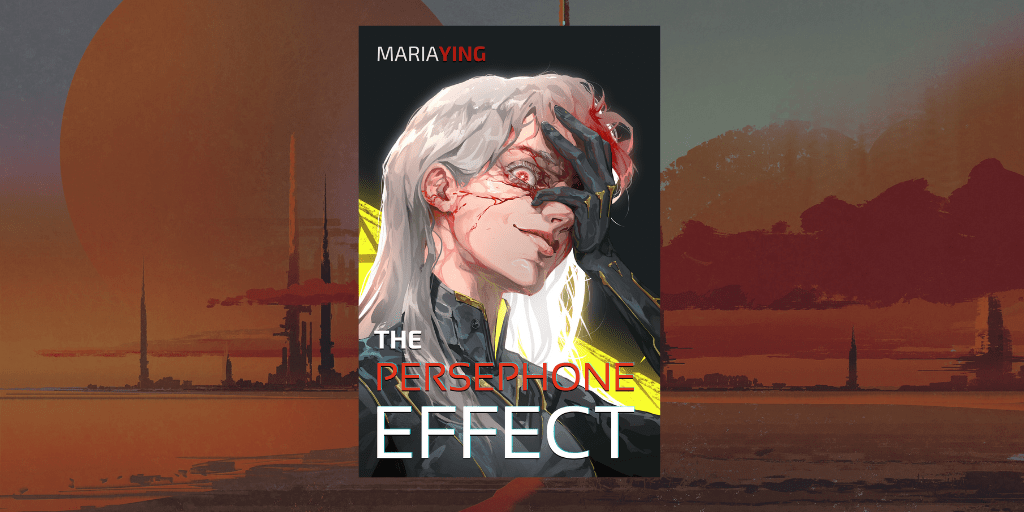
The Persephone Effect releases soon and is now available for pre-order.
 Gunmetal Olympus / Hades Calculus