Close your ears.
Sew shut your mouth, muse.
There is a terrible song, scratching at the fence of your mind. It sluices down the alleyways of the city, it snakes through the pipes. Do you hear it? Do you hear them—
♦
“Officer down—”
“Their comms just cut off, we can’t—”
“Quarantine the line!” I shouted to the Krypteia dispatchers responsible for Lixus Ward, while gearing up in the blue armor of a Krypteia captain. “Prep the forensics automata. No one goes in but me.”
Even before I arrived at the scene, I prayed to no one in particular—who would answer a god, after all—that it wasn’t what I thought it was. The facts of the matter did not engender any relief. Earlier in the evening, an hour after Apollo’s artificial light had set in the firmament, a Krypteia squad investigating strange noises coming from a closed teahouse had sent out a signal for aid. Instead of protocol language, it was alarming, disorienting. It spread to other lines, making it back to headquarters within minutes. Two other officers were dispatched to assist automatically from neighboring wards, and were unresponsive to my instructions to abort the investigation. The locator chips in their headsets had all gone dark.
The work of the Krypteia varied greatly in scale and severity. For the most part, it was a matter of confiscating old art objects that circulated in the black market of Elysium, trivial and powerless. A piece of poetry, a fragment of a painting. Out there, somewhere, a work of an artist from before the war, like Zeus’s old flame, Semele, might well have survived, kept in a dusty little box and faded almost to nothing; some portrait of a woman with mandibles for a mouth, a half-monster with compound eyes. Or a verse praising the exploits of Hermes, or a bust depicting Iapetus. Innocuous objects whose only harm is to the apparatus of propaganda, the absoluteness of the Twelve.
Sometimes, though, the artifact in question was of a different nature altogether.
I had the area cordoned off by automata: they tended to be less susceptible to the effects of Titanic technologies. It meant there was no hiding whatever it was inside, but after losing this many personnel, we were going to have to get our hands dirty with controlling the story anyway. The building in which it happened was a commercial block, after hours; fortunate that it had not been teeming with shoppers at the time. I made my way past shopfronts glittering with jewelry, art prints, beautifully illustrated book editions. One mannequin drew my eyes: it was wearing the kind of blue I was wearing, the color I’d inherited from my first pilot, but the outfit was angular in the way Vesper’s wardrobe had been rather than in my tastes. An unbidden recollection; I tried not to think of my first pilot. I rarely crossed the threshold of Hades’s catacombs to visit the facsimile of her. Vesper, whose words even as a ghost would be barbed, who would remind me that what they had was not love.
There was an ache remaining, sometimes, but I was not Hades, not Hephaestus. The ghost in the crypt was only that, a ghost. Not for the queen the comfort of the sepulcher, the open wound of tending the grave. So I kept going, and spared the mannequin no more than the one glance.
I arrived at a teahouse. The place was fragrant, even though it’d been close to a day since its most recent round of customers: the aroma of coffee and chocolate, the more complex scents of jasmine and chrysanthemum tea, the distinct notes of tea fresh and fermented. Black and red, green and white. A high-end establishment—the ones in polis blocks offered only a few, cobbled together different leaves and herbs and fruits. Still, even deprivation in Elysium was preferable to a life of ease under the Titans.
I found my officers in the kitchen. A few of them were upright. More were kneeling on the ground, in low cabinets. One officer was leaning over a sink. All were frozen mid-motion in these mundane acts, looking like nothing more than a tableau of a police force at work, investigating a crime scene.
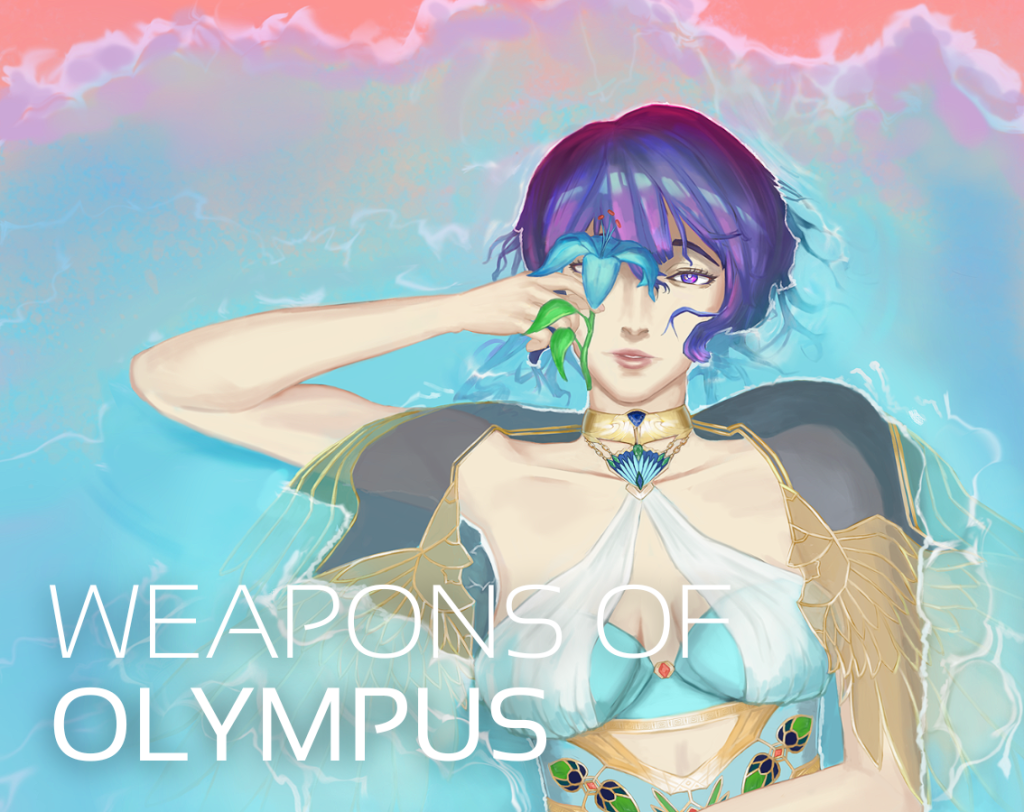
From each officer’s eye socket bloomed a lily, lustrous and rose-gold.
“Third incident this month,” Captain Semnos said, matter-of-factly, taking in the forensic information. She’d come in without me noticing and wearing little protective gear. The song had already torn through this batch, I supposed, the risk was minimal at this point. “Anything from the nymphs?”
I got Melita on the line. “Doctor. How are the Hesperides?”
There was a long pause before the reply came. “No disruptions, Your Majesty. Amusing themselves, not agitated.” There was a shuffling sound as Melita pulled up activity logs. “Nothing looks out of the ordinary over the last twenty-four; no algorithms have flagged anything. Fifty-two hours. Much the same. Is there anything I should look for?”
“That’ll be all, Doctor.”
What luck it was, to have discovered Melita some time ago—and moreover that the Hesperides nymphs had taken, if not a liking to her, then tolerance. Hera hadn’t yet experimented with more Marks to see why, but didn’t much have a need. The doctor had more than fulfilled her function, earned her keep. A Mark was the perfect confidant to keep, with information as hazardous as this. Their deaths went unnoticed by the mortal public.
I circled one of the officers, examining them from all angles, a lieutenant who’d had a promising career. Impeccable uniform, every crease ironed out. They made no response or reaction, when normally the presence of their queen would have every last one of them snapping to a salute, ramrod-straight. I scanned their devices for anything I could recover, and all I could find were failed voicemails, sent after the dispatcher had cut off their comms.
“Twelve is such a particular number, isn’t it?” came the officer’s voice, captured in a melody that, when Hera tried to recall it, was already gone from her mind. Any human listening would be seized by the need to replay it, and this officer had done so. “Too big to be so small, too small to be so big. A number that promises eternity.” And then, “It’s getting louder. Do you hear it?”
Another called out, “Do you remember it? Do your hands recall all their deeds and labors?”
Often the infected rambled like this, but it never quite added up to anything, so I stored a transcript for later and moved on. There was something obscene about the lily, in its lush excess, in its easy and gleaming elegance. The way it grew unapologetically out of its host, proud and high. The way it pushed against my senses, caressing me like an illicit lover. Perhaps this was how mortal women experienced Zeus’s attention. It made every hair on the back of my neck rise.
I seized the nearest officer by the skull, and tore the lily out.
It ripped free wetly, like an organ, trailing vitreous humor and optic nerves. The flower had rooted deep, penetrating and infiltrating the body. These things always did. As far as the brain? Yes, it must have, to have stopped every officer cold. She scraped off the viscous substance, the blood; tried to separate the optic nerves from the rose gold, to less success. Too much had become enmeshed. In her hand the lily lay deceptively still and innocuous, as though it was only a thing carved of precious metal. It revealed little of itself—its purpose, its mechanism of action. She set the lily aside in a capsule, preserving it as a specimen to be thoroughly examined later.
Despite my custody of it, I had never understood the Garden of the Hesperides, which despite its name was not truly a garden but a single enormous tree that was its own ecosystem. Rhea had given it to me, yes, but to what end had yet to become clear. I experimented with the tree and its nymphs, finding various uses. Strangely—multitudinous uses. The Titans were highly specialized in their particular arenas, and many of their artifacts tended to reflect this, being good at one particular thing. The Hesperides, though, could produce fruits that limited and harmed the gods, twisted memories; not to mention its god-like immortality.
Despite being locked away in my vault, its seeds appeared everywhere. My best guess was built off of limited observations and axioms. The garden was a gift from the All-Queen, the Titan of Life. I could only imagine the tree wanted the same thing all life—even a hybrid sort of life—wanted. To propagate. To proliferate. To reproduce. Yet, even this I knew was not the whole truth. No new trees, no new children; just flowers and blood. The nymphs, unlike those of Hephaestus, had true sapience. I wondered sometimes if they and their tree were just an extension of Rhea’s will, a dead anger, too tired and foregone to take more than a few lives at a time.
“It’s never been this many,” Semnos muttered.
I moved through the officers. I plucked the lilies out, one by one. It was already self-evident that none of them would survive it. They’d long gone past the stage where their cerebral activity had ceased, but even so I was startled when a sergeant bisected down the profile. The anterior and posterior halves teetered, perfectly split like an anatomical diagram, showing organs that had gone distorted and strange. Ziggurats and cylinders of brightly colored material, plastic-looking, in place of pancreas and lungs. A single curl of gray-black where the brain should be. There was barely any blood remaining, though all the bones were intact.
Semnos was right. In a century, I’d never seen this many taken by the infection at once. This internal metamorphosis, uncontrolled and unsettling. The lilies, as usual, had not sought to propagate themselves, at least not in any conventional manner. Instead, the flowers had altered the mortals. Imposing a will upon the world, and then vanishing again. We could not find the source, the point of origin. We had ruled out the usual channels. It wasn’t bloodborne, airborne, but rather, primarily songborne. Even if we understood this mechanism, it was a long shot to fighting back. The Hesperides couldn’t be easily transported and I’d already tried to destroy it to no avail.
Once the saplings manifested, they hungered for life force. Some of the flowers, gathered in my hand, had begun moving. They wrapped their stems around my wrist, seeking a point of entry; unable to, for I was not flesh but numinous radiance, unending and impervious. Still they tried, brushing against me in slow susurrus. The flowers flexed and convulsed like muscles. I knew it was to the beat of that damned song, but I could grasp no more.
“Initiate cleanup,” Semnos commanded to both automata and the squad waiting at the perimeter.
Contacting family and loved ones to determine whether they were safe or whether the melody had caught on their lips, too. Shutting this place down for the foreseeable future. All of this—these lives, these tea leaves—would become evidence in the one case the Krypteia would never solve. It was the best we could do. That’s what we told ourselves when we lost lives, to keep us from losing ourselves, too. There was nothing more for it, and I knew that. The tree had been claiming victims for a century. Like so much else in Elysium, it was a scar from a long time ago we had to accept would never quite heal. Our only hope was to grow beyond Elysium, and hope its wounds did not follow us.
I was just about to leave, when a sudden pain bloomed in my left arm. Pinpoint, like an awl. The line to my new pilot, Cydippe, opened. Labored breathing, a pitched wheeze came through the line.
“Majesty. Hera,” she half-spoke, half-sang. “Can you hear it?”
♦
Ganymeda’s hangar was deserted. Not a replicant rat running along the coolant reservoirs, not a bird perched on the skylight. My footsteps echoed loudly against the sterile white. Her blue wings drooped—my mechanics didn’t even have the time to secure her properly into the bay. I did not look up to meet her gaze. Troublesomely, I did not take to my eidolon as easily as the rest of the Twelve. Their tethers were stead steadfast. I felt like I was connected to Ganymeda a threadbare rope, dangled above the open sea. I was nauseous just looking at her. Her faceplate, so accusatory, her upturned shoulders so condescending. On her long, pale arm, splotches of rose-gold. Scaled up to her size, they were enormous, enough of them to cover an entire human body, to turn flesh into a statue of rose-gold.
Before her, othe floor of the loading dock, body curled up as if in prayer, Cydippe hummed to herself and clutched her left arm.
Elysium had been haunted by the melody chewing at the hollow of her mouth for longer than she’d been alive. It had consumed many more than my officers tonight. Because there was no one else, and because I would allow no one else to take my pilot’s dignity, I peeled her out of her gear. She shivered, skin damp and soft with sweat. Rose-gold stains, hard and metallic, were mottled all over her skin.
Her head lolled, and she recognized me. “I have no children,” Cydippe said. “Can you hear them?”
The shape of her voice, weighted by the sickness, was a scythe that harvested the air from my chest. I could have sworn I’d heard it before. And I wondered—entertained, ever so briefly the idea that the song had crept into my mind, had already begun undoing me from the inside out.
With a finger I parted Cydippe’s sweat-ruined hair. Melita notified me we had a room prepared for her nearby, but I found it hard to gather her up and move. Humans were so small, so fragile, like beautiful shells on the shore; I did not wish to break her. I had been slow to take on pilots, and Herakles’s recommendation was not a quick study. She had the heart and the vigor, proving herself by putting her body on the line to save lives during the attack on Wall Caryatid. But my fears had not been allayed by her display of heroism. She had spent her life carving votives and reciting prayers. She came abundant to my door with passion and drive that were not matched by her constitution.
Her rates with Ganymeda had been abysmal at first, to the point that I thought we might have to retire her early. But I couldn’t. Since Persephone’s debut in Elysium, I suspected the state of Elysium would only deteriorate, and there was no better contingency for a god than her Banner-class. Still, after training these last couple of months, Cydippe would spill out onto the loading dock, stinking of sweat, Ganymeda hissing behind her as if upset at this transgression. Bleeding from her ears or her mouth, she’d mutter prayers to herself. I thought nothing of it—a pilot’s work was brutally taxing, whatever got her through the moment was worth her effort.
I brought her to the room we’d prepared for her, and laid her down. It was as empty as a tomb. This struck me, as much as a colossus’s spiked limb piercing through Ganymeda’s arm would have.
“Will you… with me… when we’re up there?” Cydippe said, coughing into my chest. “Do you know their names, Hera?”
“Does that mean anything to you, majesty?” Melita asked through the double sided glass.
“I don’t know,” I said, though I couldn’t be sure. Each word was a sharp, knife-like wound between my eyes, smudging the words by the time I’d processed them. I only half-understood what I was hearing, but I knew I’d heard it before, like I knew I’d heard the song, even if it sneaked out of my mind the moment I tried to sing it.
Either way, I needed to figure this out fast. I’d known the officers I’d lost tonight for years. I knew their sparse family. I knew their limited interests. I knew their hopes, desires—fears. I would know more officers—their ranks were already being replenished by the great sacrifice of Elysium’s people. Though I had not truly known Cydippe until recently, her life, by dint of her ability to pilot a Banner-class, made it far more dangerous to lose her. A pilot was not so easy to replace.
I have no children, she said. How queer. Was that the sickness, or something she’d been considering for herself? I did not know her to have partners, despite her winsome appearance and good social standing. She was a pretty girl, but it did not seem she cared much about the carnal side of living. It made sense—my worshippers were less sexually gratuitous than most.
The phrase reminded me of something, but I couldn’t figure out what. Like Cydippe, I was never a mother. Zeus’s edicts explicitly forbade it.
Returning to Ganymeda, I tried to examine the patch of rose-gold on its arm. This was, as far as I could tell, artificial. Banner-classes were the bridges between mortals and gods, and perhaps she was displaying a kind of empathy. Then again, there was a time, long before our mythology of ourselves, where gods fell like flies. The killing of a child of light need not be as dramatic as the rending of guts, the excavation of viscera from its housing. It could be as bloodless as an asphyxiation, as quiet as the pressure of a hand on a baby’s throat.
♦
I needed a fresh set of eyes on this case, or I was going to lose another pilot.
I’d made the foolish assumption when Zeus asked for my hand in marriage that she would be my primary . That it would be a council of two, with the rest of the Twelve delegated to their own corners of the city. Yet in the years since the war, I have come to know Zeus in parts. The charismatic leader, winsome against the onslaught of the paparazzi. The lascivious writer, whose appalling work I burned whenever it came to my desk. The woman I loved, so much piecemeal.
Athena, of course, was aware—as she was aware of all things—but had offered limited assistance on the case at hand. I had a mote of pride and went to her only when necessary. My detectives worked hard and brought a necessary mortality and sentience to the job. It would be undignified to rely heavily on Athena’s powers of foresight, particularly because they were more limited and cost so much more than she—we—let the rest of the Twelve believe.
I rarely found myself at the threshold of Athena’s Aerie, her brutalist palace, gray wrought from gray. Thick, seamless walls that would challenge mortal perception, the scent chalky and dry, like a quarry, like uncarved stone. She arrived like a shadow, peeled herself out of the coarse gray
“Lend me your oracles,” I said to her, and passed the case files through our dataspheres.
She considered the files, and me, before responding. “Of course, my queen. However, I don’t imagine they’ll be much help to you. You’re asking about something that has already happened,” she said, unhelpfully.
“I need to understand where this is going. I need to save my pilot.” I stood there, the wind fussing with my robes, until she gave me an acquiescent bow of the head and allowed me inside.
Athena’s oracles were arranged in a shallow pool, deep in the heart of the Aerie, joined to Gorgoneion. She had other members of her faith stationed at her temples, the sort who told quotidian fortune. Making calculations for the humdrum troubles of this or that artisan, student, soldier. Such things required little processing power, barely a blip in Athena’s awareness, but fed back all the same into her system of prediction. The mortals didn’t realize that their little entreaties and inquiries gave away a wealth of data, didn’t understand that they volunteered intimacies to the One Who Watches. Even if they did, they would continue all the same. To have their fear of the future soothed was worth any price. Privacy was a sacrifice they could tolerate.
But these were a unique sort. The number of oracles was not always consistent—at the moment, Athena had three. Every figure was hidden behind armored robes the color of pewter, faces concealed behind helmets made of metal feathers, hammered so thin that they looked finer than the real thing. No holes or visors for the eyes. It was as if I was addressing three statues, all sculpted toward an alien ideal. From the backs of their necks was the site of a most holy union: mortal flesh parted to accept Gorgoneion. Three needle-like lengths led back to her modified cradle, no longer the housing for a mere cockpit.
The oracles did not turn to face me; instead they faced the pool itself, as if each wave carried a mortal’s future. I watched several crash against each other before asking.
“How does this work?” I asked Athena, but she’d already vanished.
Disembodied, her voice came to me, a low rasp like a gust over the waves. “Step within. Ask.”
“This case…” I said, but as I stepped in the pool, I struggled to recall what I was here for. The light fog I’d noticed before began to thicken all about me. I opened my mouth but nothing came out. There was a case… a songborne sickness. Where had my files gone? I opened my datasphere, but it was empty. Vast black depths of empty storage.
“Athena!” I called out, but she was not there. Only her oracles, only their eyeless gazes.
As I stepped closer to them, the pool became deeper than I expected, and the waves, which had looked to me only a moment ago like those on a pond, like those on a glass of untouched water, were now moving me this way and that, like great currents. A bitter, briny scent overtook me.
The water was angry, seemingly that I’d dared to ask it something wrong. “The only remembrancer more practiced than yourself is the Lord of the Underworld,” came a voice from very far away. “Our memories are like the dead—sit with them, commune with them. Ask them.”
This was a fool’s game. I tried to walk out, away from the oracles, floating above the water like omens. But I stopped as I turned, noticing a trick of the light. Something that could not be there. I held up my own left arm for inspection. There, a patch of rose-gold over perfect, untouchable, divine skin.
And without noticing, I had come upon the oracles. Some vertiginous wedge made them feel even taller than myself. That should be impossible. They were only flesh and blood, perishable.
“I have upon me a strange stain,” I told the faceless heads, holding my hands up for them to see. “Tell me how I would be rid of it.”
Each of them twitched toward me.
“All hail, Hera! Hail to you, Bride of the King.”
“All hail, Hera! Hail to you, Custodian of the Sacred Fruit.”
“All hail, Hera! Hail to you, that shall be queen hereafter.”
Was I a queen? My assistant’s robe flowed like one, in wind and fog such as this. But the King’s bride… that surely referred to Rhea.
“I am no queen!” I told them. “I am a child of light, handled by the good prince Vesper. I am no custodian of fruit! I work under the sea with the Titan of Time!”
Yes, yes, that was right. I was occluded from the courts. There was no domain granted to me, no authority at all. It was the first line, Hades and Zeus, who were meant to rule.
“There is a child that you loved once, who loved you in turn,” said each of the oracles.
“Preposterous,” I said. I was not permitted to have children.
But out of the fog came the echo of an echo of a feeling. I remembered speaking to someone in the lab, not Cronus, not my handler.
“There is a shape you cannot recall,” said the first oracle.
“A shape, like a gift to the mother,” said the second, and then questioned herself, “or from the mother.”
“A loss gifted to another self,” said the third.
“I don’t understand,” I snapped. “I’m asking about the stain. Don’t you see it? It proliferates. Speak clearly—you are only mortal, and a god commands you. There is no queenship for me; Rhea, Father’s wife, is queen and prospers still. How could her throne possibly become mine? The stain: look at it.”
“Hail,” the first oracle whispered.
“Hail,” the second echoed.
“Hail,” the third insisted.
I tried to leap upon them, to wring their necks for real answers, but when I did, the fog had thickened to the point of closing in on me. I found myself in a gray lab. Everywhere I went in the lab, I saw golden handprints, motes of a marvelous light that did not belong to me. They clung to glass, to metal, to paper. My attempts to wipe them off availed me little. They were tenacious, sticking to material and my hands alike, even though that should be impossible—or more possible, because I was made of the same composition. The motes stayed and stayed, holding on to me like a stubborn child unwilling to part from its mother. There was a sink, and I rushed over to it. I lathered up soap and ran endless water and scrubbed, and still they would not go. I tried oil and increasingly esoteric solvents and acids, but even the strongest—the sort that would strip the paint from a war-machine’s—did nothing. Even shapeshifting did not free me of the remnants.
“Gone in little time,” said the first oracle, “but in greater joy than Hera’s eternity.”
“Never knowing war,” said the second, “this brief youth, yet surviving it all the same.”
“So all hail, Hera and—”
I bent over and threw up, and for a moment it seemed as though what came out of me was not bile at all but a hundred thousand lilies. They ripped free wetly, like little organs, trailing vitreous humor and filaments of nerves. They rolled and spread in the pool, but then they were gone and the pool was pristine again—
Athena’s knuckles were on the back of my neck, and I was suddenly on the cold, coarse gray floor of the Aerie. I coughed up water and she pulled me upright.
“What the fuck,” I asked, “was that?”
“Wrong question,” Athena said, shrugging. “It must play itself out, Queen of Eternity. Even your affinity cannot hasten it along.” Infuriating, as always, entirely her father’s daughter.
♦
Athena did not so much as apologize for the uselessness of her oracles, saying merely that they had used precious computational cycles to answer my questions. You should appreciate them a little, the Owl said. I do. They are the mechanisms through which great work is possible.
I’d rolled my eyes at this and vowed to deny any license of marriage those awful creatures ever requested. The disrespect, from them and their lord. Athena had never called me her stepmother, even though by all rights she should, this child of my wife. It took significant discipline to not spit profanities at her as I left her hangar.
And anyway, by then I no longer felt or saw the stain. My senses had settled. The day felt right again, as right as it could be with my pilot sick and the rose-gold mystery being no closer to its solution. What a maddening waste of time.
But then, if Athena had deemed it suitable for me to know what she knew—and it was impossible to say how much she knew—she would have already given me those answers herself. Dealing with her was, in so many ways, worse than dealing with Zeus. With my wife, there were things I could do, levers I could pull, until eventually I could arrive at a place I wanted, in some matters at least. With Athena, it was like screaming at Wall Caryatid, which could be moved by no appeal, no cajoling.
And so I turned to my one friend, something like my confidant when all else failed.
While I waited for em by the sea, I stood under a certain tree and remembered—
Weapons of Olympus is available to preorder on Itch.io and Amazon.

